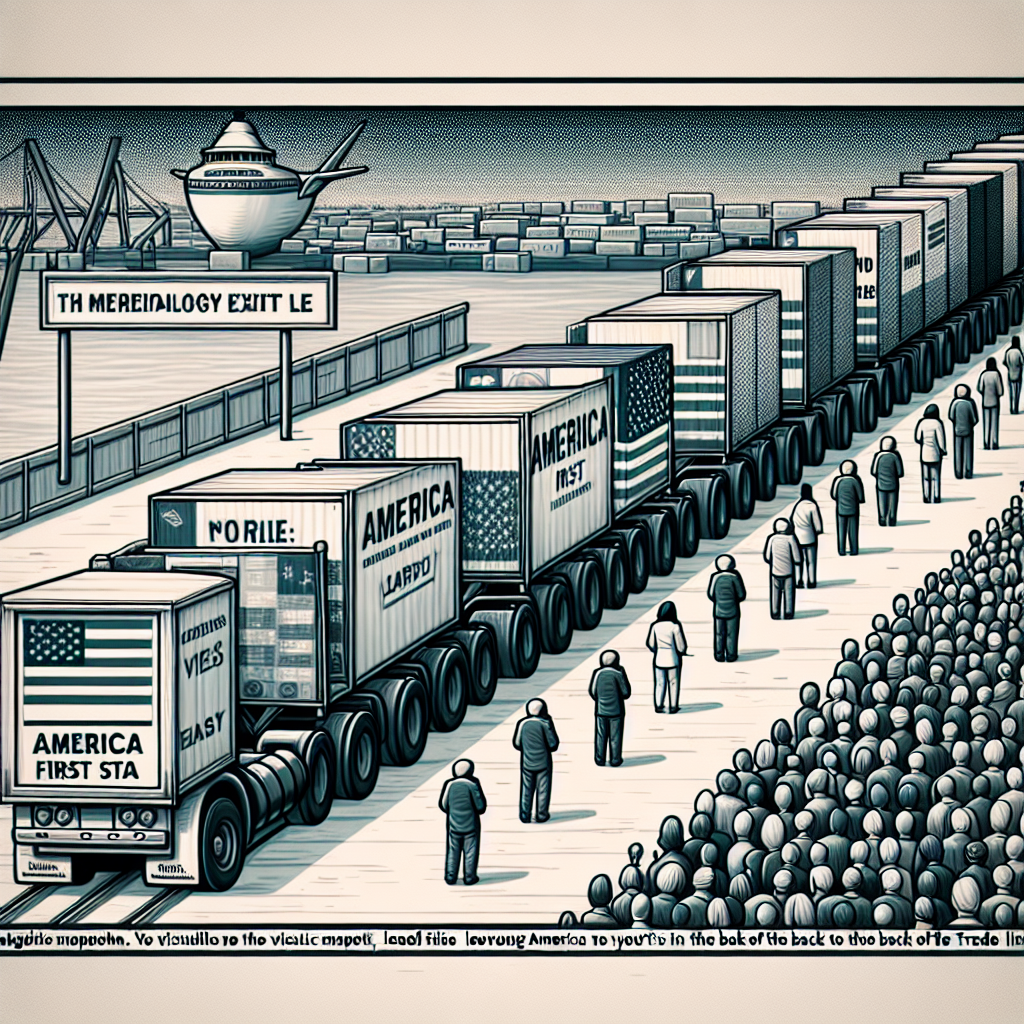
Trump’s Trade Tangle: How His ‘America First’ Policy Risks Putting the U.S. Last
An Analysis of the Current Trade Landscape
In the aftermath of Trump’s trade policies, the global economic environment is evolving in unexpected ways. While the mantra of “America First” resonates as a pursuit of national benefit, the structural consequences of such a philosophy may lead to profound challenges in the U.S.’s standing in the global marketplace. With global trade dynamics shifting, the U.S. risks not only diminished partnerships but also an unsettling reality where it finds itself increasingly isolated.
Economic Readjustments and Positive Indicators
As of early 2025, the U.S. economy appears to be performing well on the surface. Manufacturing sectors are flourishing, evidenced by a recent payroll report indicating that the economy added 228,000 jobs, surpassing the anticipated 180,000. Foreign investments are progressively pouring in, with major corporations making substantial commitments: Hyundai’s $20 billion investment in electric vehicle factories, TSMC’s $100 billion towards chip manufacturing, and SoftBank’s even more impressive $100 billion pledge.
Trump’s administration has even introduced a $5 million “gold card” visa meant to encourage global elites to invest and settle in the U.S., promising potential financial gains for the domestic market. While these signify beneficial steps, a closer examination reveals underlying tensions and the repercussions of trade policy decisions.
The Hidden Costs of Tariffs
Trump’s imposition of tariffs—25% on foreign cars and 10% on steel—was meant to serve as a wake-up call to allies and competitors alike. However, the unintended consequences highlight the precariousness of American economic relations. Nations that once viewed the U.S. as their foremost trading partner are now recalibrating their alliances.
Historically, the U.S. has maintained a relatively stable trade-to-GDP ratio, fluctuating between 23% and 31% since 2010. In contrast, global trade as a share of world GDP has experienced a near doubling over the same period. This divergence indicates that while the U.S. clings to its traditional roles, the approach may no longer be tenable in an increasingly interconnected world.
Shifting Alliances and Growing Distrust
The consequences of the U.S.’s departure from cooperative trade policies have rapidly materialized. Just days after the tariff announcement, trade ministers from China, Japan, and South Korea convened for the first time in five years with plans to expedite their trilateral free trade agreement. They are already amplifying their commitment to the Regional Comprehensive Economic Partnership (RCEP), a collaboration that excludes American engagement.
Additionally, India and China, long-time regional rivals, have found common ground, signaling an erosion in the U.S.’s influence in Asia. Brazilian President Luiz Inácio Lula da Silva is circumventing dialogues with Washington, opting instead to strengthen trade relationships across Asia—an assertive movement reflective of many nations seeking alternatives to U.S. markets. Even Canada is reassessing its decades-long partnership, with Prime Minister Mark Carney highlighting a shift away from reliance on the U.S.
The Reality of American Involvement
As the U.S. contemplates its strategic orientation, it must grapple with the emerging sentiments of its trading partners. A recent survey from CapGemini indicates executives now favor stable and predictable supply chains, even at an increased cost, in light of unpredictable U.S. policies. This shift raises questions regarding America’s reliability and the underlying tenets of its exceptionalism.
Conclusion: The Consequences of Isolation
As the geopolitical landscape evolves, the self-reliant “America First” ideology may inadvertently sow the seeds of America’s obsolescence in the global economy. What once seemed an unquestionable dominance is now at risk of becoming a distant memory—a troubling prospect suggesting that if U.S. stakeholders do not adjust their approach, this may lead to a future where America stands alone, engaging in an economic game in which it is unwittingly set aside.
The risk is not solely about economic decline; it is more alarming in its potential for the U.S. to become irrelevant amidst a rapidly changing world. If American policymakers do not harmonize with these new realities, the “America First” agenda could rapidly devolve into an “America Alone” scenario—a turning point that would redefine global trade for generations to come.